Seaweed Types · Fucoidan and phlorotannins
Brown seaweed: fucoidan and phlorotannins.
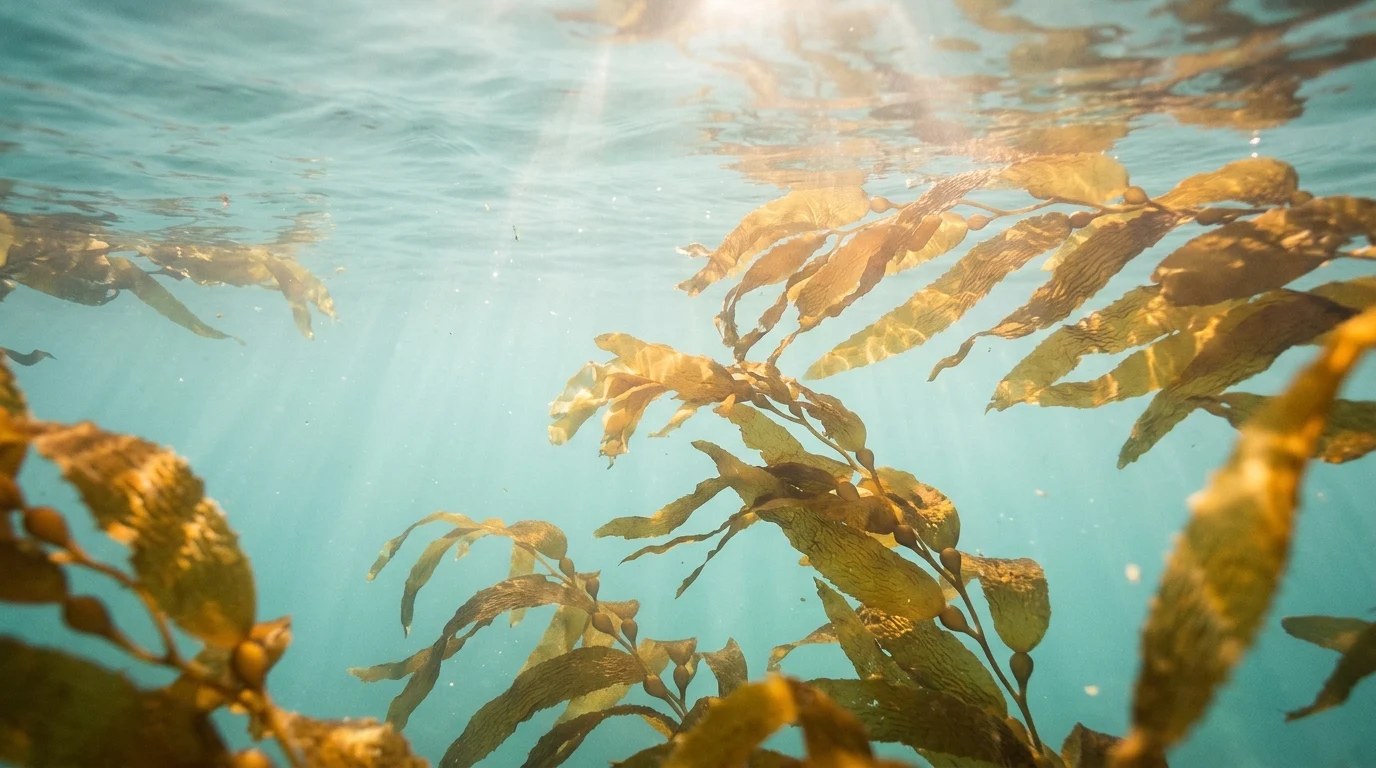
Fucus spiralis and Alaria esculenta are among the brown seaweeds in the studies we read. The skin research on them is mostly laboratory work on two compound families, and this page keeps to what those studies measured.
In short
01
What laboratory studies measured
Fractions of Fucus spiralis were tested for antioxidant, enzyme-inhibiting, anti-inflammatory and photoprotective capacity. The best one inhibited collagenase at 0.037 µg/mL and elastase at 3.0 µg/mL, and cut UVB-induced reactive oxygen species (IC50 31.3 µg/mL).2
A second brown seaweed’s ethyl acetate fraction inhibited collagenase, elastase and tyrosinase, reduced UVA and UVB ROS in mouse 3T3 cells, and lowered TNF-α and IL-6 in mouse macrophages. Both groups link the effects to phenolic compounds such as phlorotannins.25
Three purification methods applied to one Djibouti brown alga enriched different phlorotannins. The liquid-liquid fraction held the most complex mix, including phloroglucinol, diphlorethol/difucol, fucophlorethol and bifuhalol.3
02
The tyrosinase result, in context
An ultrasound extract of Dictyopteris justii inhibited tyrosinase with an IC50 of 0.51 mg/mL, against 46.61 µg/mL for kojic acid. By those figures the extract was roughly eleven times weaker than kojic acid, although the authors call the activity significant.4
03
Fucoidan, and a caution
A review of fucoidans against oxidative stress says results vary with differences in source species, extraction, purification and molecular weight, and calls for standardized chemistry and better pharmacokinetic data. Two of its authors work for a fucoidan producer.1
What we could not confirm
The gaps, stated plainly.
- Whether any brown seaweed extract changes skin colour, collagen or wrinkles in people. The studies we read are laboratory tests.
- A standard dose or form of fucoidan or phlorotannin for skin.
Questions
Common questions.
What is fucoidan?
A fucose-rich sulfated polysaccharide derived mainly from brown seaweeds, according to a review on oxidative stress.1
Do brown seaweed extracts lighten skin?
The evidence we found is from enzyme tests. A phlorotannin-rich extract inhibited tyrosinase with an IC50 of 0.51 mg/mL against 46.61 µg/mL for kojic acid, so it was far less potent in that assay.4
Keep reading
Back to the full guide: Seaweed Types.
More in this guide
- Red seaweed: 3,6-anhydro-galactose polysaccharides.
- Green seaweed: ulvan and hydration.
Related research
From our library
Sources
Where every claim comes from.
Numbers in brackets link to these entries. Journal entries were read as their PubMed record, and study details come from PubMed, the US National Library of Medicine. See every source on the Research Desk, organised by page.
- [1] Archives of Toxicology (Mangoni and colleagues; two authors are from Marinova Pty Ltd). Therapeutic role of fucoidans against oxidative stress: recent developments, translational challenges, and future directions.
- [2] Antioxidants (Freitas and colleagues). Highlighting the biological potential of the brown seaweed Fucus spiralis for skin applications.
- [3] Marine Drugs (Nour and colleagues). Eco-friendly extraction of phlorotannins from a brown macroalga abundant in Djibouti: identification related to purification methods towards innovative cosmetic applications.
- [4] Scientific Reports (Hernández and colleagues). Optimization of ultrasound extraction of phlorotannin-rich extract from Dictyopteris justii with tyrosinase inhibition.
- [5] Marine Drugs (Susano and colleagues). Unravelling the dermatological potential of a brown seaweed.
This page is general information drawn from published studies. It is not medical advice and makes no claim about any Vanu Health product. The image is an AI-generated illustration, not a study image. Last updated October 30, 2026.