1 in 5
At least one in five Americans will develop skin cancer by age 70. This is a US figure, cited by the Skin Cancer Foundation.6
Research Desk · Sunlight
Sunlight makes vitamin D in your skin. The same ultraviolet light also ages skin and can cause skin cancer. This guide separates the two, uses Canadian data where it exists, and cites every claim.

01 · The light
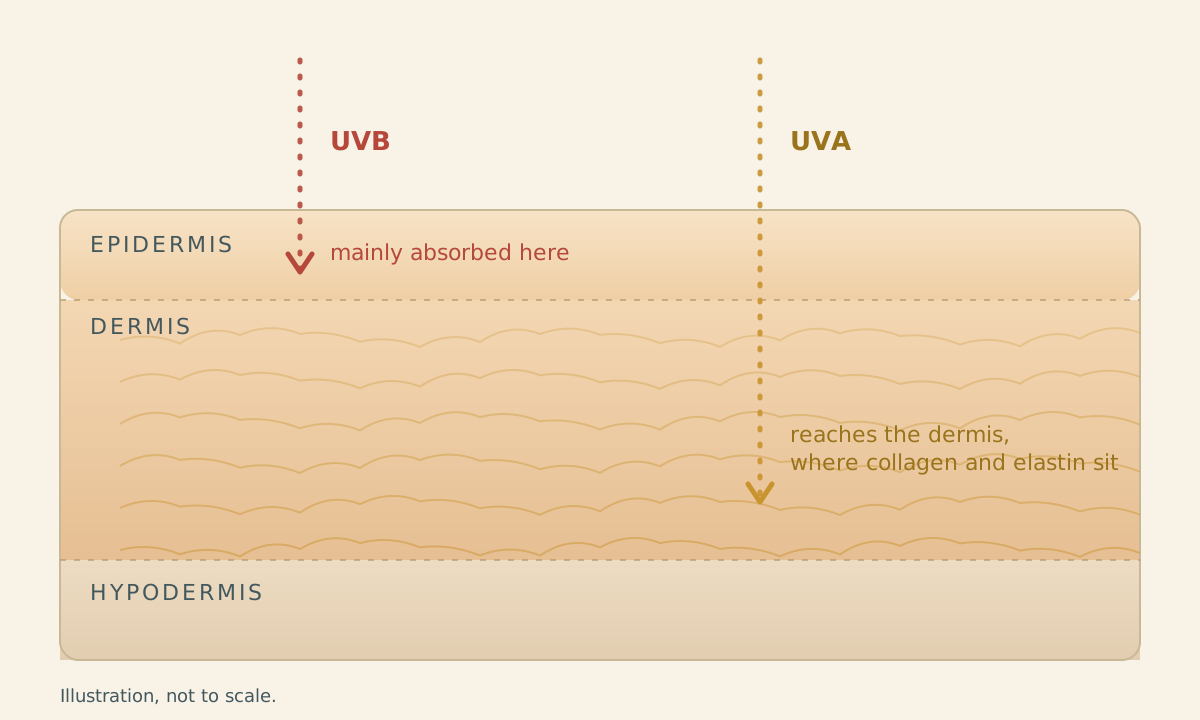
Two ranges of ultraviolet light matter for skin. UVA is 315 to 400 nanometers and UVB is 280 to 315 nanometers.1 UVC is blocked before it reaches the ground.1
| UVA | UVB | |
|---|---|---|
| Wavelength | 315–400 nm1 | 280–315 nm1 |
| Share of UV at the ground | About 95%1 | The remainder. Most UVB is filtered by the atmosphere.1 |
| How deep it goes | Into the deeper layers of the skin1 | Cannot penetrate beyond the superficial skin layers1 |
| Skin aging | Contributes to skin aging and wrinkling1 | Enhances skin aging1 |
| Skin cancer | May enhance the development of skin cancers1 | Significantly promotes the development of skin cancer1 |
UVC does not reach the Earth's surface (WHO).1
02 · Vitamin D
UV rays from sunlight trigger vitamin D synthesis in the skin.2 Most people in the world meet at least some of their vitamin D needs through sun exposure.2
How much vitamin D the skin makes depends on how much skin is exposed, the time of day, the season, latitude and skin pigmentation.3 People with darker skin have more difficulty getting enough vitamin D from sun exposure.3
Share of Canadians aged 3 to 79, by serum 25(OH)D level.3
Cut-offs are from Health Canada and the Institute of Medicine, as cited by Statistics Canada.3 The NIH uses the same thresholds in ng/mL.2 1 ng/mL = 2.5 nmol/L.
Jan
Feb
Mar
Apr
May
Jun
Jul
Aug
Sep
Oct
Nov
Dec
Shading is approximate, by whole month. Statistics Canada: in fall and winter, from late October to early March, “very few UV rays reach the earth's surface.”3 The University of Calgary's Zwicker (2015) adds that the sun is too low in the sky for vitamin D synthesis during Canadian winter months, and that most of Canada lies north of the 42nd parallel.4 Edmonton is well north of that line.
Solar noon altitude at about 53.5° N, calculated as 90° minus the distance from the solar declination to the latitude.
Shortest, lowest sun
Mid-season
Longest, highest sun
This is a calculation from latitude and the sun's declination, not a measurement. Statistics Canada lists time of day, season and latitude among the factors that affect vitamin D made from sun exposure.3
What this means for you. No single number of minutes in the sun works for everyone. Because skin type, season and latitude all change the result,3 whether you need a supplement is a question for a doctor or pharmacist, who can check your blood level. Our research desk does not recommend vitamin D doses.

03 · Skin aging
The WHO says UVB enhances skin aging, and UVA contributes to aging and wrinkling.1 This is often called photoaging: skin aging driven by sun exposure rather than time alone.
The Skin Cancer Foundation cites a study finding that an estimated 80% of visible skin aging in Caucasian women is caused by the sun.6 The same source reports that women who used sunscreen daily showed 24% less skin aging than those who did not.6 Both figures come from specific study populations, so treat them as estimates.
Diet is a separate factor we study. Our AGE food rankings measure dietary advanced glycation end-products (AGEs) in 490 foods, and cooking with dry, high heat produces far more of them. See the AGE food rankings.
Our guide The Truth About Wrinkles tests the famous “80% sun” claim against the research.
04 · Skin cancer
1 in 5
At least one in five Americans will develop skin cancer by age 70. This is a US figure, cited by the Skin Cancer Foundation.6
Doubles
The Skin Cancer Foundation reports that a person’s melanoma risk doubles after more than five sunburns, citing a 2001 study by Pfahlberg and colleagues.6
UV radiation is a carcinogen, and UV exposure is the most preventable cause of skin cancer.2 The WHO says UVB significantly promotes the development of skin cancer, and UVA may also enhance it.1
For melanoma, the American Cancer Society says frequent severe sunburns as a child or teen increase the risk as an adult, and that melanoma can appear many years after the DNA damage was done.7 Tanning-bed use has been linked with increased melanoma risk, especially when it starts before age 30.7
05 · Protection
Use enough.8
Most adults need about 1 ounce, roughly a shot glass, for the body. For the face, use at least 1 teaspoon.
Add shade and clothing.9
No sunscreen can block 100% of UV rays. Seek shade and wear sun-protective clothing with a UPF label.
0–2
Low
3–5
Moderate
6–7
High
8–10
Very high
11+
Extreme
The scale is set by the WHO, UNEP and WMO and published by ICNIRP, with these bands and colors.5 For today's reading in your area, check your local UV index forecast.
Our DermaGlass® masks are skincare, not sunscreen. They do not replace the protection described above.
06 · Questions
Both. UV light from the sun starts vitamin D production in the skin. UV radiation is also a carcinogen, and UV exposure is the most preventable cause of skin cancer. It contributes to skin aging as well. 12
Usually not. Statistics Canada reports that from late October to early March very few UV rays reach the earth’s surface. Whether you need a supplement depends on your blood level and your health, so ask a doctor or pharmacist. 34
Both. The WHO says UVB enhances skin aging and UVA contributes to aging and wrinkling. UVA penetrates into the deeper layers of the skin. 1
About 1 ounce, roughly a shot glass, for the whole body, and at least 1 teaspoon for the face. Choose SPF 30 or higher and reapply every two hours, and immediately after swimming or sweating. 8
No. No sunscreen can block 100% of UV rays, so the American Academy of Dermatology also recommends seeking shade and wearing sun-protective clothing with a UPF label. 9
Tanning beds and sunlamps emit UV rays. The American Cancer Society says they can cause long-term skin damage, and tanning-bed use has been linked with an increased risk of melanoma, especially when it starts before age 30. It does not rank them against sun exposure. 7
Yes. The American Cancer Society says frequent severe sunburns as a child or teen increase the risk of melanoma as an adult. The Skin Cancer Foundation reports that a person’s melanoma risk doubles after more than five sunburns, citing a 2001 study by Pfahlberg and colleagues. 67
There is no single reliable number of minutes. Statistics Canada lists how much skin is exposed, time of day, season, latitude and skin pigmentation as factors, and says people with darker skin have more difficulty getting enough vitamin D from sun exposure. 3
Sources
Numbers in brackets link to these entries. Each was read at the link above; the date shown is the one the source gives.
All sources across the Research Desk are collected, by page, in the master source list.
This page is general health information from the Vanu Health Research Team. It is not medical advice and does not replace a conversation with a doctor or pharmacist. Last updated October 25, 2026.