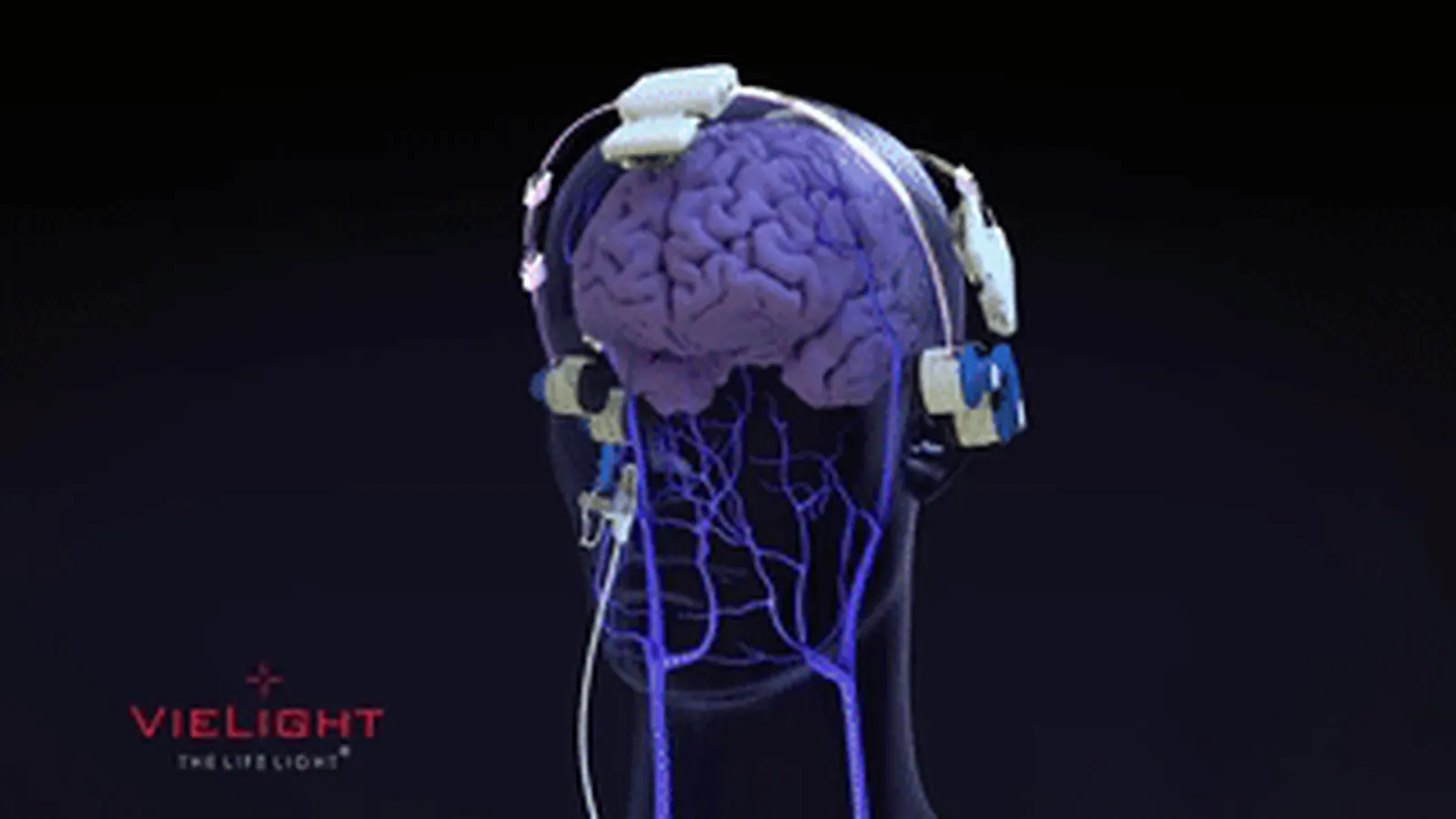
What is the Vielight Neuro?
Vielight’s Neuro devices are lightweight headsets with LED modules that rest against the scalp, plus a small clip that shines light into the nostril. The Neuro line includes the consumer Neuro devices and the more configurable Neuro Pro 2; the Neuro RX Gamma is the research version used in clinical trials.
The approach is called transcranial and intranasal photobiomodulation (PBM): low-power light, not heat or a laser cutting tool.
More Vielight devices
The maker’s website lists ten products. Its own statements: “Vielight technology is not FDA approved,” and its devices are “general wellness products.” Several are marketed for uses we have not reviewed, such as thymus stimulation and immune support.
Vielight Neuro Pro 2
Brain · customizable
A configurable brain headset with relaxation and focus modes.
Maker’s product page (opens in a new tab)Vielight Neuro Duo 4
Brain · focus and calm
One device with a focus and memory mode, and a calming mode.
Maker’s product page (opens in a new tab)Vielight Neuro Gamma 4
Brain · focus and productivity
Marketed for focus, memory and productivity.
Maker’s product page (opens in a new tab)Vielight Neuro Alpha 4
Brain · calm and sleep
Marketed for calm, creativity and sleep, used before bed.
Maker’s product page (opens in a new tab)Vielight Vagus
Vagus nerve · stress
Vagus nerve stimulation through light, marketed for relaxation and stress.
Maker’s product page (opens in a new tab)Vielight Neuro Duo 4 + Vagus
Bundle · brain and vagus
A bundle that gives brain and vagus nerve stimulation in sequence.
Maker’s product page (opens in a new tab)Vielight X-Plus 4
Thymus · immune support
Marketed for thymus stimulation and immune support.
Maker’s product page (opens in a new tab)Vielight MIP 470-633-655-810
Mental performance · immunity
Four light sources, LEDs and lasers, marketed for mental performance and immunity.
Maker’s product page (opens in a new tab)Vielight MIP 655-810
Mental performance · immunity
An 810 nm near-infrared LED with a 655 nm laser, marketed for mental performance and immunity.
Maker’s product page (opens in a new tab)Vielight MIP 633-810
Mental performance · immunity
An 810 nm near-infrared LED with a 633 nm LED, marketed for mental performance and immunity.
Maker’s product page (opens in a new tab)
How it works
Near-infrared light at around 810 nm can pass a short way through the scalp and skull. In cells, it is absorbed by cytochrome c oxidase, an enzyme in the mitochondria that makes energy. Lab studies show this can raise cellular energy (ATP), increase blood flow and reduce inflammatory signalling.
Gamma models pulse the light at 40 times a second. The idea comes from research linking 40 Hz gamma brain rhythms with memory, and from animal studies of 40 Hz stimulation in Alzheimer’s models.
For the history and science of red and near-infrared light, see our book The Accidental Discovery of Redlight Therapy.
What the research shows
Early pilot studies in a handful of people with dementia reported improvements on cognitive tests, but they were small and had no sham group.
A randomized, double-blind, sham-controlled pilot trial in long-COVID brain fog (43 people, 8 weeks of home use, published in eClinicalMedicine in 2026) found no significant improvement across all ages. A prespecified group under 45 improved on a composite cognitive score, and attention showed signals of improvement; fatigue and mobility measures favoured the sham. There were no serious side effects. The study was funded by Vielight and led by its founder.
A larger trial of the Neuro RX Gamma in Alzheimer’s disease (NCT03484143) is listed on ClinicalTrials.gov without posted results.
Overall: the biology is plausible and safety looks good in short studies, but there is not yet strong evidence that it improves memory or slows dementia.
Who it is for
Adults curious about this device as a wellness tool for brain health, who understand the evidence is early.
People with a diagnosed neurological condition should treat it as an experiment to discuss with their doctor, not a replacement for care, and may look for clinical trials.
Safety
Short studies report few side effects. The light is not aimed at the eyes. Talk to a doctor first if you have epilepsy or a seizure disorder, are pregnant, or have a brain implant or recent head injury.
Questions
Is the Vielight Neuro FDA approved?
No. It is sold as a general wellness device and is not cleared or approved to treat Alzheimer’s or any other disease. The medical version has been studied in clinical trials.
Does it improve memory?
The evidence is early. Small studies are encouraging, but a sham-controlled trial in brain fog found no overall benefit, with a signal only in people under 45.
How is it different from a red light panel?
It uses near-infrared light aimed at the head and through the nose, and some models pulse at 40 Hz. Red light panels mostly target skin and muscle.
Sources
- Vielight: official website (opens in a new tab)
- Vielight: randomized trial in long-COVID brain fog (summary of the eClinicalMedicine paper) (opens in a new tab)
- ClinicalTrials.gov: NCT03484143, Neuro RX Gamma in Alzheimer’s disease (opens in a new tab)
- Being Patient: review of light devices for brain health (opens in a new tab)
- PubMed: transcranial photobiomodulation and cognition (opens in a new tab)
Vanu Health does not sell this device and is not paid by its maker. General information, not medical advice. Read our terms.